Kitchen - Part 2 - Movement and Safety
Kitchen Ergonomics: Designing for Movement and Safety
By OAK Architecture and Design
A beautiful kitchen is useless if you cannot open the dishwasher without blocking the walkway. While the layout determines the general shape of the room, ergonomics dictate how it feels to use. This science of movement ensures that counters are at the right height, aisles are wide enough for traffic, and dangerous appliances have safe "drop zones."
The "Landing Zone" Rule
One of the most critical yet overlooked aspects of kitchen safety is the "Landing Zone." This refers to the countertop space immediately adjacent to major appliances. Without these zones, a cook is forced to walk across the kitchen holding a hot roasting pan or a heavy bag of groceries, increasing the risk of spills and burns.
The Refrigerator Center requires a landing space on the handle side of the door. Ideally, this is a clear counter width of at least 380mm to 400mm. This allows you to remove items and immediately set them down. For side-by-side refrigerators, this landing zone should be easily accessible to the fresh food section, which is accessed more frequently than the freezer.
The Cooktop and Oven: Safety is paramount here. A cooktop should have heat-resistant landing spaces on both sides—ideally 300mm to 400mm wide. This allows a cook to slide a heavy pot off a burner in an emergency without having to lift it. For wall ovens, ensure there is a landing zone immediately next to or directly across from it (no more than 1200mm away) to ensure hot dishes have a safe resting place immediately upon removal.
The Sink Center is the hub of cleanup. To function efficiently, it requires a minimum of 450mm to 600mm of clear counter space on one side for stacking dirty dishes and at least 450mm on the other for drying clean ones.
Designing for Circulation: The Two-Cook Reality
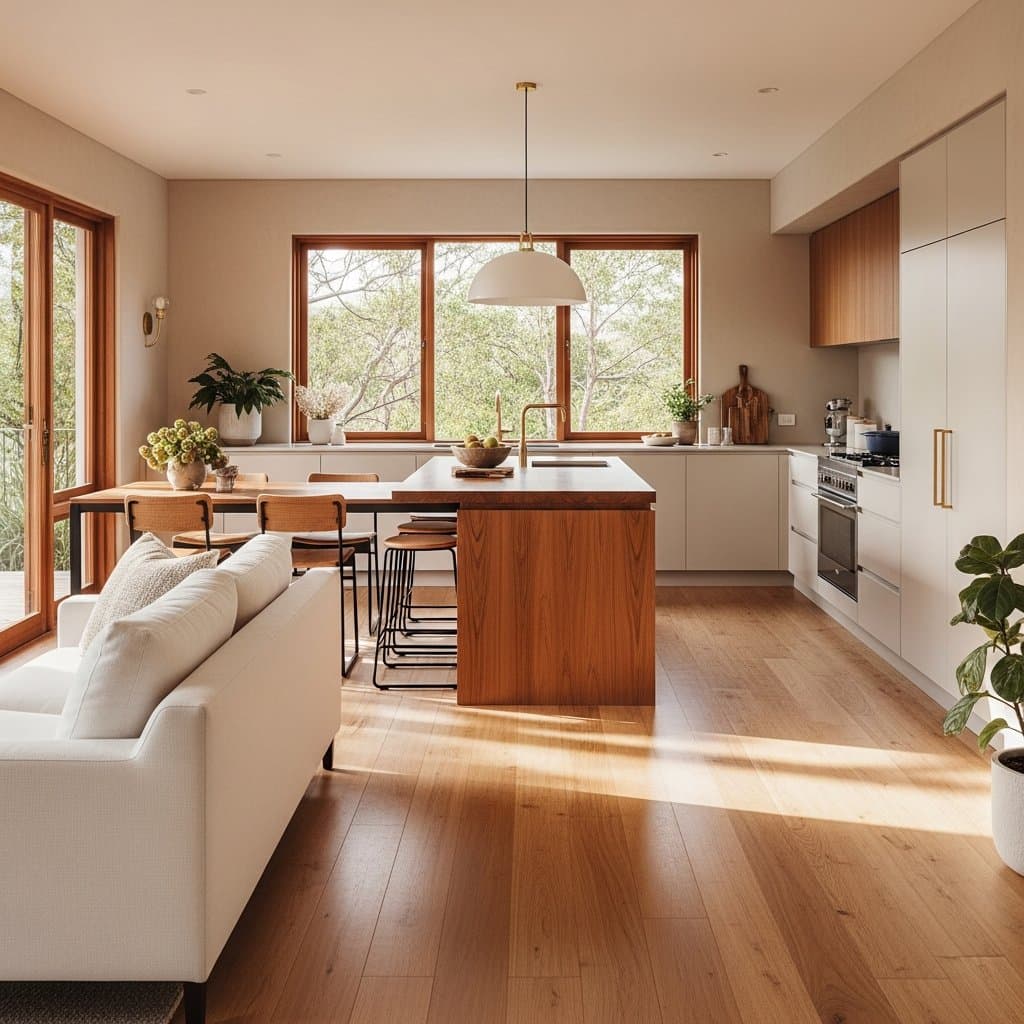
In modern Australian open-plan living, the kitchen is rarely the domain of a single person. Children, guests, and partners often share the space, making aisle width a primary concern.
For a kitchen designed for a single cook, a minimum clearance of 1050mm between facing cabinets is generally sufficient. However, if your household frequently has two people working simultaneously, this width should expand to at least 1200mm. This additional width prevents the classic "hip bump" dance when one person is chopping at the island and another is passing behind them to access the fridge.
It is also vital to distinguish between a "work zone" and a "walkway." If a kitchen aisle serves as a thoroughfare to another room (e.g., walking through the kitchen to get to the laundry or alfresco), the width should be increased to 1500mm. This ensures that a person walking through does not collide with an open oven door or a cook backing up from the sink.
The Physics of Appliance Doors
Appliances are dynamic; they open, close, and extend into the room. A common design failure is placing appliances where their doors conflict with one another or with traffic flow.
The dishwasher is the biggest culprit. When fully open, the door protrudes significantly into the aisle. To load it comfortably, a user needs clear floor space adjacent to the sink—roughly 600mm is recommended between the open door and any corner or obstruction. Furthermore, the dishwasher should never be placed where its open door blocks the primary path into the kitchen, creating a tripping hazard during cleanup.
Similarly, ovens should be positioned away from major traffic aisles. A hot oven door opening into a busy pathway is a recipe for injury. If you choose a wall oven, ensure there is a landing zone immediately next to or across from it (no more than 1200mm away) to ensure hot dishes have a safe resting place immediately upon removal.
Vertical Ergonomics: Reach and Height
While standard counter heights are typically set at 900mm – 950mm to accommodate the average adult, this is a compromise that does not fit everyone.
For taller individuals, constant stooping can lead to back pain, while shorter cooks may struggle to gain leverage. In custom architectural design, we often explore varied heights—perhaps raising the island to 1050mm for a comfortable bar-height workspace, or lowering a section of the prep zone to 850mm for tasks that require downward pressure, like kneading dough.
Storage zones also follow ergonomic logic. The "sweet spot" for heavy use is between knee and eye level. Heavy items like mixers or cast-iron pots should be stored in deep drawers in the base cabinets, not on high shelves where retrieving them requires a precarious balancing act.
Summary
Ergonomics is the invisible luxury of a kitchen. When the clearances are correct, the kitchen feels spacious and intuitive. When they are ignored, cooking becomes a series of small frustrations. By respecting the rules of landing zones and circulation widths, we create spaces that remain a joy to use for decades.