Document - Swept Path Analysis – How vehicles can move in and out of your home
What is a Swept Path Analysis and Why Do I Need It?
You have designed the perfect garage and a beautiful driveway. But there is one burning question the Council or Certifier needs answered before they approve it: "Can a car actually get in and out?"
It sounds simple, but on steep or narrow sites, a standard driveway design often fails. To prove your design works, you need a Swept Path Analysis.
Here is a guide to understanding this technical diagram and why it is the key to unlocking difficult sites.
What is a Swept Path Analysis?
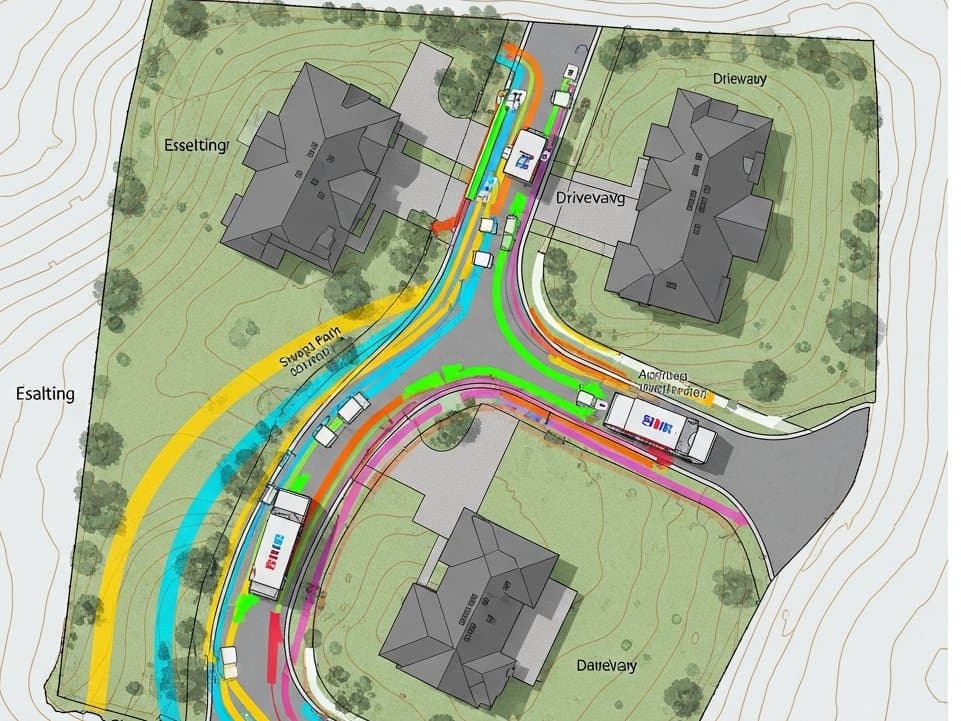
A Swept Path Analysis is a computer simulation that predicts the movement of a vehicle.
Unlike a simple floor plan that shows a car as a static rectangle, a Swept Path shows the car in motion. It calculates:
- The Wheel Path: Where the tyres go on the road.
- The Body Overhang: Where the bumpers and mirrors swing (which is often wider than the wheels).
- The Clearance: The safety gap between your car and the fence or wall.
Why do you need it?
Both Councils (for DA) and Private Certifiers (for CDC) enforce Australian Standard AS 2890.1 (Parking Facilities) rigorously. They generally require a Swept Path for three reasons:
- Forward Entry and Exit: If you live on a busy road, Council will usually require you to enter and leave your property in a forward direction. You cannot reverse out into traffic. A Swept Path proves you have enough space to perform a 3-point turn inside your property.
- Steep Driveways: If your driveway is steep, the simulation checks for "scraping." It ensures the bottom of the car won't hit the concrete at the top or bottom of the ramp.
- Narrow Sites: On "Battle-axe" blocks or narrow terraces, it proves that a standard car can navigate the tight turns without hitting the fence.
What information is included?
The diagram usually looks like a series of coloured tracks overlaid on your architectural plan.
It specifies the Design Vehicle used for the test. In NSW, you will typically see:
B85 Vehicle: The "85th percentile" car (a standard Ford Falcon/Toyota Camry size). Used for most residential parking spaces.
B99 Vehicle: The "99th percentile" car (a large 4WD or luxury sedan). Used for checking driveway widths and ramps.
SRV (Small Rigid Vehicle): A small truck/garbage truck. Council may request this if you have a long driveway and need waste collection on-site.
When is it required?
This is required during the approval stage, whether you are doing a DA or a CDC.
- For DA: Council engineers will often refuse to assess the application until they see proof the driveway works.
- For CDC: Private Certifiers cannot issue a Complying Development Certificate unless they are certain the driveway complies with the Housing Code and Australian Standards. If the access looks tight, they will mandate this report before signing off.
Common Pitfalls and Professional Advice
The biggest mistake is forgetting the "Overhang." Tyres fit, but the body might not. We often see driveways where the wheels stay on the concrete, but the front bumper swings out and hits a wall. At OAK Architecture and Design, we use Swept Path diagrams to "shave" corners. If the simulation shows the bumper clipping a garden bed, we can adjust the design to make it work before pouring any concrete.
How to obtain a Swept Path Analysis
This is prepared by a Traffic Engineer. We coordinate this for you. We send your architectural CAD files to the Traffic Engineer. They run the simulation software and give us the result. If the computer says "Fail" (the car hits the wall), we work with the engineer to tweak the curves and gradients until we get a "Pass," ensuring your driveway is safe and compliant.
Don't get stuck in a tight spot.
Access is just as important as aesthetics. If you have a challenging site and need a team that understands the technical geometry of parking, contact OAK Architecture and Design today.