Designing Social Spaces Part 1 - The Living room
The Living Room & The Rule of Six
The days of the formal "parlour"—strictly separated from the kitchen and saved for special occasions—are largely behind us. Modern Australian living revolves around interaction. Whether you call it a Lounge, a Family Room, or part of a "Great Room," the function is the same: to bring people together.
However, a large open room can easily feel cavernous or chaotic if not planned correctly. To design a space that feels comfortable, we must look beyond the furniture style and focus on human behaviour.
1. The "Rule of Six"
Research into social interaction suggests that large groups naturally splinter into smaller conversations. If you put 12 people in a room, they won't form one giant circle; they will break into two or three smaller groups.
This phenomenon dictates our layout strategy: The Rule of Six.
The Concept: A single seating arrangement should be sized to accommodate a maximum of six people. Beyond this number, cross-conversation becomes difficult, and the group fractures.
The Dimensions: A functional "Conversation Cluster" requires a diameter of roughly 3.6m to 4.0m. This keeps everyone close enough to hear without shouting, but far enough apart to respect personal space.
Furniture Spacing: To support normal voice levels, seating should be spaced approximately 1.2m to 3.0m apart. Any further, and the intimacy is lost.
Architect’s Insight: In expansive Great Rooms, rather than buying a giant sofa for 12 people, it is more effective to create multiple distinct clusters—for example, a primary seating zone for six and a secondary zone (like a game table or reading nook) nearby.
2. Circulation: Perimeter Flow
The location of doors and hallways significantly impacts the functionality of a leisure space. A common mistake in open-plan design is allowing the walkway to cut through the conversation circle.
Perimeter Movement: Circulation paths should flow around the outside of the seating group.
Door Placement: Multiple doorways on different walls can turn a room into a thoroughfare. By grouping entry points or minimizing distinct pathways, we preserve the integrity of the gathering space.
3. Anchoring the Room: The Rug
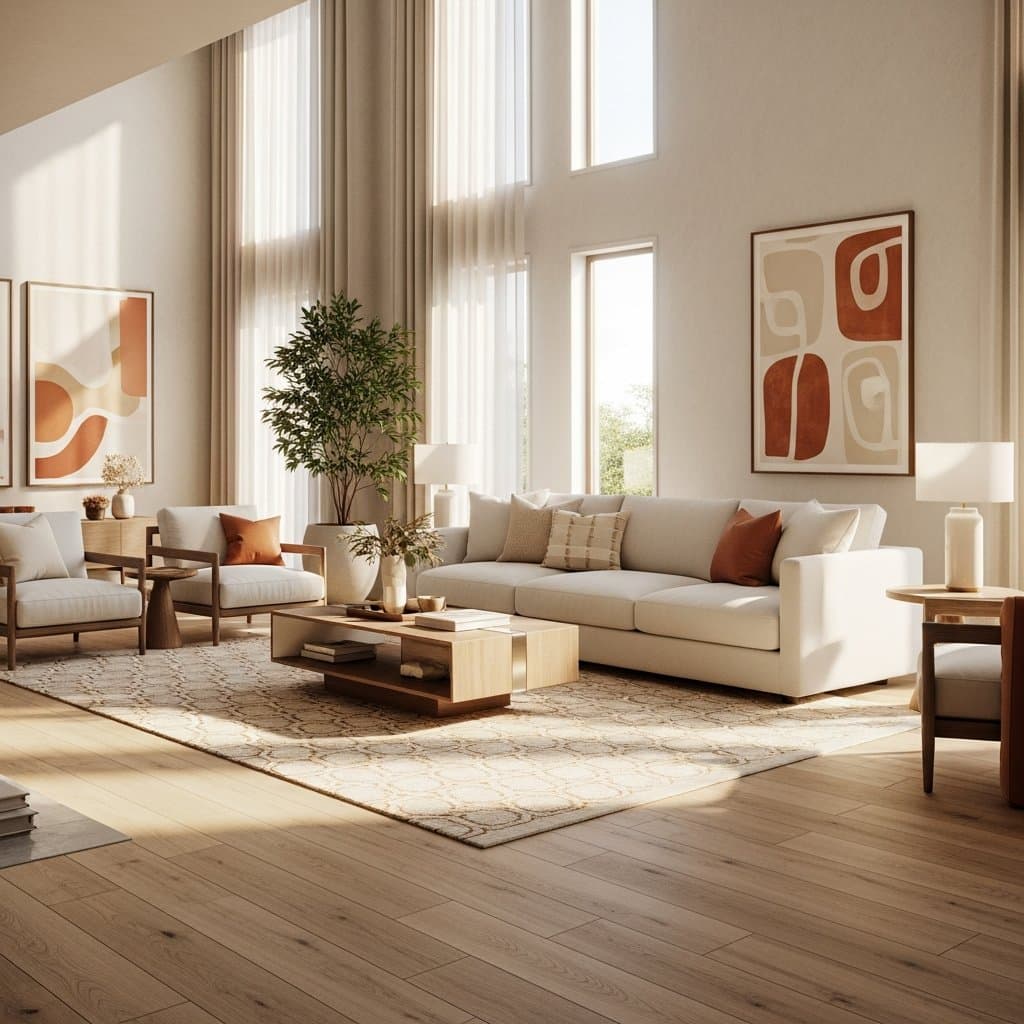
In a room without walls, the rug is the wall. It defines the boundary of the "Living Zone."
The "Front Legs" Rule: A common mistake is choosing a rug that is too small (the "postage stamp" effect). To make the room feel grounded, the front legs of all seating (sofas and armchairs) should sit on the rug. This visually ties the furniture together into a cohesive island.
The Size: For most Australian open-plan homes, a 3m x 4m rug is the standard requirement to achieve this look.
4. The Focal Point & TV Ergonomics
Every social space needs an anchor. In the past, this was the fireplace. Today, it is often a view, an artwork, or—let’s be honest—the television.
Aligning the Focus: If you have multiple focal points (e.g., a fireplace and a TV), you must align the furniture so the room doesn't feel pulled in two directions. Stacking the TV above a linear fireplace or placing them side-by-side on a feature wall creates a single visual direction.
The Media Wall Ergonomics: as televisions grow larger, placement becomes critical for health. A common mistake is placing the TV too high (the "Sports Bar" effect), which causes neck strain.
The Height Rule: Ideally, the centre of the screen should sit at eye level when you are seated.
The Dimension: This typically means the centre of the screen is approx. 1000mm – 1100mm off the floor.
Summary
A well-designed living room uses invisible geometry to control the social vibe. By respecting the "Rule of Six" and ensuring traffic flows around (not through) your guests, you create a space that feels welcoming rather than chaotic.