Utility - Part 3 - Garage
The Garage: More Than Car Storage
By OAK Architecture and Design
In many Australian homes, the garage is the largest room in the house, yet it is often the most neglected. It becomes a dumping ground for camping gear, bikes, and half-finished DIY projects, eventually forcing the cars to park in the driveway.
A well-designed garage is a precision-engineered storage facility. To function effectively, it requires strict zoning and dimensions that account for modern vehicle sizes (which are getting larger every year).
1. Dimensional Reality Check
The old standard "double garage" (5.5m x 5.5m) is no longer sufficient for modern SUVs and dual-cab Utes.
Minimum Dimensions
Internal Depth: A standard garage is 6000mm deep. However, a Ford Ranger or Toyota Hilux is roughly 5400mm long. This leaves only 600mm of clearance. If you want a workbench or shelving at the front, you need a garage depth of 6500mm to 7000mm.
Door Height: If you own a 4WD with a roof rack or lift kit, the standard 2100mm door height is a risk. We specify a 2400mm high opening to ensure clearance for modified vehicles.
2. Zoning: The "3-Wall" Strategy
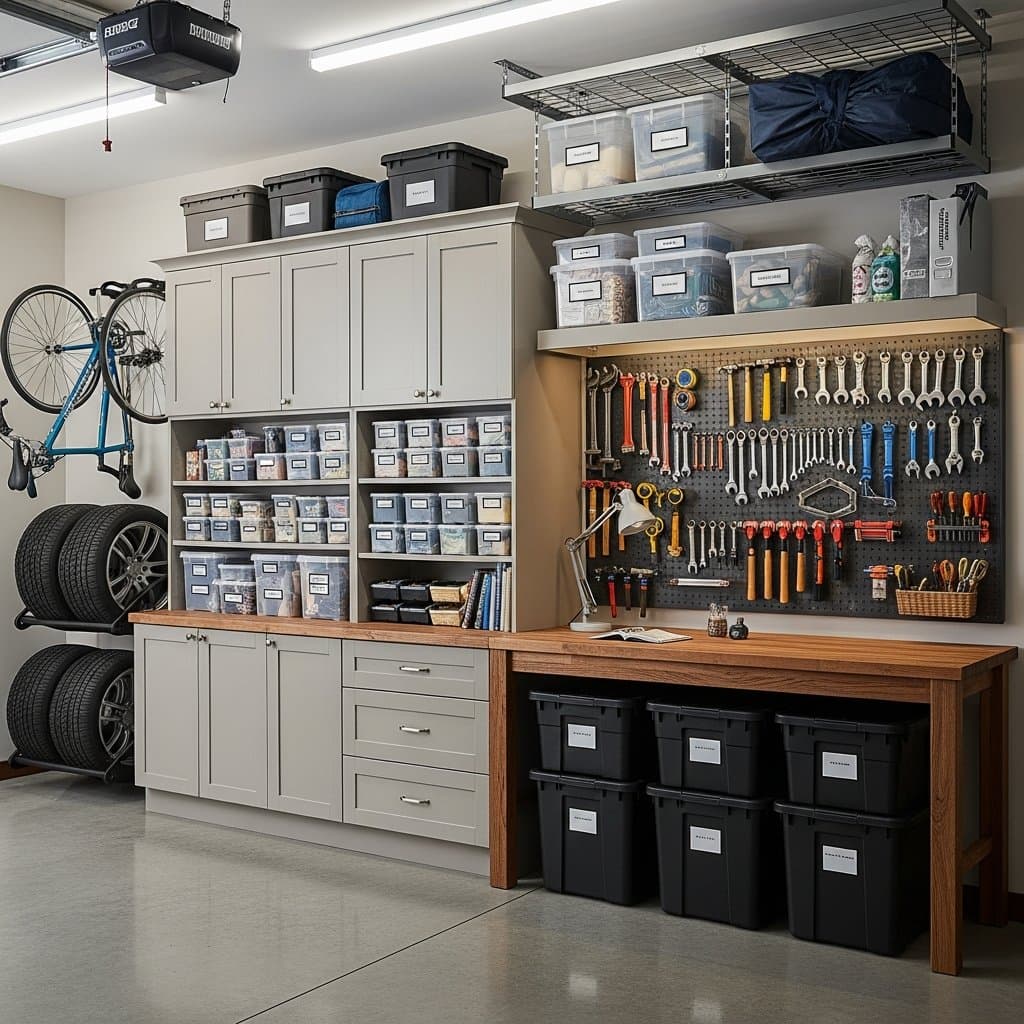
To keep the floor clear for cars, you must utilize the walls. We zone the garage based on frequency of use.
Wall 1: The "Daily Grab" (Internal Access) The wall closest to the internal door into the house.
Storage: Hooks for school bags, dog leads, and wet coats.
Shoe Rack: A shoe dump zone here prevents dirt from being tracked inside.
Wall 2: The "Weekend Warrior" (Side Wall) The long side walls are for bulky items.
System: Use a slat-wall or track system rather than fixed shelving. This allows you to rearrange hooks for bikes, whipper snippers, and ladders as your needs change.
Depth Control: Keep cabinets shallow (300mm–450mm) on the side walls to ensure car doors can still open fully.
Wall 3: The "Long Term" (Rear Wall) This is the deep storage zone.
Heavy Duty: Steel shelving for camping tubs, Christmas trees, and archive boxes.
The Workbench: If space permits, this is the safest place for a workbench, as it is away from the car doors.
3. The EV Revolution: Charging Infrastructure
Even if you do not own an Electric Vehicle (EV) today, building a garage without EV readiness is a mistake that will hurt your resale value.
Future-Proofing
The Circuit: Retrofitting a high-speed charger later can be expensive if your switchboard is on the other side of the house.
The Specification: Install a 32-amp single-phase (or 3-phase if available) dedicated circuit to the garage wall. Even if you don't install the charger yet, having the heavy-duty cable in the wall saves thousands down the track.
4. The Floor Finish
Concrete dust is the enemy of a clean house. Raw concrete constantly sheds dust that gets tracked inside.
Epoxy Flake: The gold standard. It is oil-resistant, easy to sweep, and looks showroom-quality.
Penetrating Sealer: A cheaper alternative that binds the concrete surface to stop dusting without the glossy look of epoxy.
Summary
The garage is the true "front door" for the family. By adding just one metre to the depth and pre-wiring for EVs, you turn a concrete box into a future-proof asset.