Utility - Part 1 - Laundry
The Modern Laundry: Layout and Flow
By OAK Architecture and Design
In the hierarchy of household spaces, the laundry has traditionally been the "Cinderella room"—hidden away, poorly lit, and purely functional. However, in modern Australian design, the laundry has evolved. It is now often an extension of the kitchen or mudroom, featuring the same high-quality joinery and stone benchtops as the rest of the house.
A functional laundry is a production line. It needs a clear workflow: Sort -> Wash -> Dry -> Fold. Here is how to design a layout that takes the drudgery out of wash day.
1. Location and Type: Room vs. Cupboard
The first decision is spatial. Do you need a dedicated room, or is a "European Laundry" sufficient?
The European Laundry (The Cupboard) Ideal for apartments or smaller townhouses, this conceals the appliances behind bifold or pocket doors (usually in a hallway or bathroom).
The Pros: Saves roughly 4–6 square metres of floor space.
The Cons: You lose the ability to have a "dirty zone." Once the doors are open, the mess is in your hallway. It also lacks space for hanging rails and ironing boards.
The Dedicated Room For family homes, a separate room is standard. Ideally, this should be located near the bedrooms (where the clothes live) or have direct access to the outdoors (for drying).
The Mudroom Hybrid: The most efficient modern layout combines the laundry with the "Mudroom" or entry drop-zone from the garage. This creates a single wet-area buffer where muddy shoes and school bags can be dumped before entering the main house.
2. The Workflow: Sort, Wash, Dry, Fold
The layout should follow the logic of the laundry cycle to minimize movement.
Zone A: Sorting (The Dirty Zone) Clothes shouldn't land on the floor.
Joinery Solution: We often design pull-out hampers integrated into the cabinetry—one for lights, one for darks.
Benchtop: A sorting bench above these hampers allows you to separate items without bending.
Zone B: Washing & Drying (The Wet Zone)
Stacked vs. Side-by-Side:
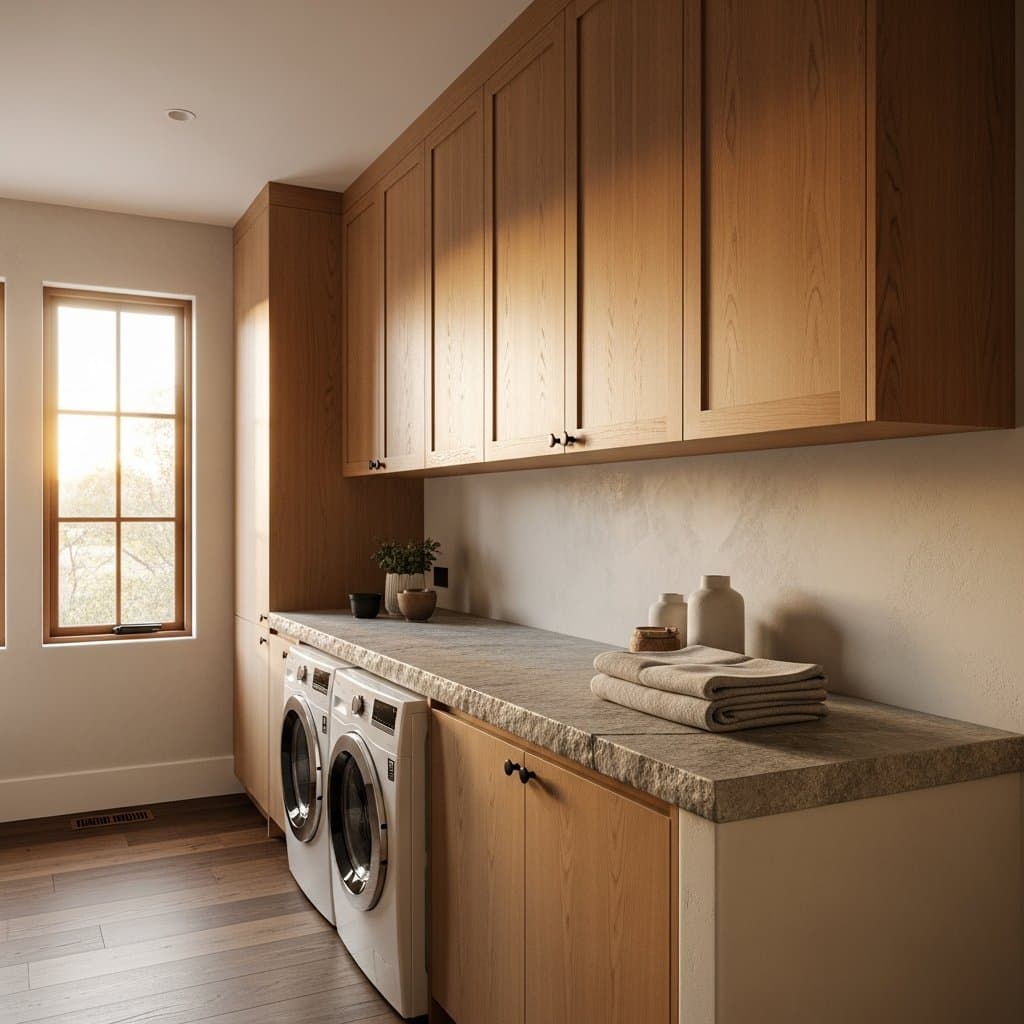
Side-by-Side: Allows for a continuous benchtop running over both machines. This is the best option for families as it provides maximum folding space.
Stacked: Saves floor space but sacrifices the benchtop. This is better suited to European laundries or tight utility cupboards.
The Sink: A deep stainless steel or fireclay tub is essential for soaking. It should be located immediately next to the washing machine to transfer dripping wet clothes without making a mess.
Zone C: Drying & Folding (The Clean Zone)
Hanging Rail: An overhead rail (mounted under the upper cabinets) is critical for air-drying delicates or hanging ironed shirts immediately.
Bench Depth: A standard laundry bench is 600mm–650mm deep. This is perfect for folding towels and organizing stacks of clean washing.
3. Ergonomics: Top Loader vs. Front Loader
Your choice of appliance dictates the cabinetry design.
Top Loaders: These are robust and popular, but they kill your bench space. You cannot run a counter over a top loader, meaning you lose roughly 700mm of valuable folding area.
Front Loaders: The architect’s choice. They allow for a seamless benchtop, look cleaner, and are generally more water-efficient.
Raised Height: For ergonomic luxury, we can raise the machines off the floor by 300mm–400mm (on a reinforced plinth or drawer). This brings the drum to hip height, meaning you don't have to squat to load the washing.
4. Ventilation and Drying
Moisture management is critical to prevent the laundry from becoming a mould trap.
The Drying Cupboard: A specialized joinery unit with wire racks and a dedicated exhaust fan or ducted heating vent inside. It dries school uniforms and damp coats out of sight.
External Access: Ideally, a glass door leads directly to the side path or clothesline, allowing for cross-ventilation and easy access to the sun.
Summary
The laundry is a workspace, not a storage room. By treating it as a production line and choosing appliances that maximize bench space, you turn a chore into a seamless process.