The Art of Circulation - Part 2 - Staircase -Elevating Your Home’s Flow
The Art of Circulation - Part 2 - Staircase - Elevating Your Home’s Flow
In residential design, areas dedicated purely to movement—stairs, hallways, and landings—are often seen as “wasted space.” Homeowners understandably want to minimise these zones to maximise bedrooms or living areas. Yet circulation is the artery of a home. It determines how spaces connect, how light travels, and how the house feels to move through every day.
A well-designed staircase does far more than move you between floors. It shapes the experience of the home, frames views, builds anticipation, and ensures long-term comfort and safety. Below is our guide to designing vertical circulation that works as beautifully as it looks.
Choosing the Right Stair Configuration
Stairs are one of the most space-demanding and permanent elements in a floor plan. Selecting the right form is a careful balance between available space, functional efficiency, and architectural impact.
Straight-run stairs consist of a single uninterrupted flight and deliver a bold, modern aesthetic. They can be visually striking, but they require a long horizontal run—often 3.5 to 4 metres. They also move occupants from one side of the home to the other, which can complicate how upper and lower floor plans align.
For most homes, switchback stairs (L-shaped or U-shaped) are the more efficient option. By turning 90 or 180 degrees and doubling back, they allow the upper landing to sit directly above the starting point. This simplifies stacking floor plans, reduces the overall footprint, and improves safety by breaking a potential fall with an intermediate landing.
Spiral stairs are the most compact and sculptural solution, typically fitting within a footprint of around 1.8m × 1.8m. However, their tight geometry makes them difficult to use for furniture, laundry, or everyday traffic. For this reason, they are best suited to mezzanines or secondary access points rather than primary circulation.
Getting the Basics Right
The Maths of Comfort
If a stair feels awkward or tiring to climb, the proportions are usually to blame. In Australia, stair geometry must comply with strict NCC requirements.
Riser (height)
Must be between 115mm and 190mm
The most comfortable range is typically 170–180mm
Going (depth)
Must be between 240mm and 355mm
We generally aim for 250–280mm to ensure the foot is properly supported
Walking Formula
The NCC assesses comfort using the formula:
2 × riser + 1 × going = 550–700mm
When this relationship falls outside the range, stairs feel disjointed and unsafe to use.
Balustrades and the “125mm Sphere” Rule
Open or “floating” stairs are a popular request, but safety regulations—particularly for children—are strict.
No opening in a staircase or balustrade may allow a 125mm sphere to pass through (roughly the size of a child’s head).
Open risers are permitted, provided the gap between treads remains under 125mm.
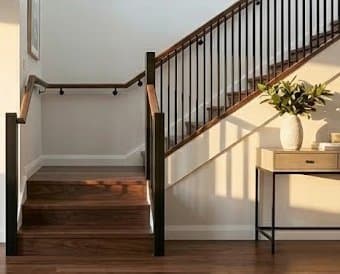
Horizontal rails, while visually sleek, can act like ladders for toddlers. Although often permitted in standard houses, many clients prefer vertical battens or glass for added peace of mind—especially around large voids.
Designing for Everyday Safety
Statistically, stairs are one of the most hazardous elements in a home. Good design reduces this risk through consistency, visibility, and proportion.
Adequate headroom is essential. A minimum clear height of approximately 2 metres above the stair nosing prevents the subconscious urge to duck when descending. Handrails must be continuous and comfortably graspable, offering reliable lateral support.
Consistency is critical. The human brain operates on muscle memory when climbing stairs. Even small variations between riser heights can cause trips. Precision in construction is non-negotiable, and this is reinforced by proper lighting—each tread should be clearly illuminated, with shadows kept to a minimum.
Future-Proofing and the Lift Question
Many homeowners now design with “ageing in place” in mind. While ramps are often assumed to be the solution, they are rarely practical inside two-storey homes. A wheelchair-accessible ramp requires a gentle slope (typically 1:12), meaning one metre of height demands 12 metres of ramp—an unrealistic use of floor space.
For multi-storey homes, a residential lift is far more efficient. Even if a lift isn’t part of the immediate budget, planning ahead makes a significant difference. A common strategy is to vertically align spaces such as a ground-floor pantry beneath an upstairs linen cupboard. This creates a ready-made shaft that can later be converted into a lift with minimal structural disruption.
The Stair as a Light Well
A staircase should be more than a passageway—it can act as the home’s internal atrium. Because stairs typically require a void, they present a perfect opportunity to introduce natural light. Skylights or tall vertical windows placed within the stairwell allow light to filter down through multiple levels, transforming a functional zone into a bright, uplifting core of the home.
Vertical movement is about more than getting from one floor to another. It is a balance of safety, efficiency, and architectural beauty—one that shapes how a home is experienced every day.
If you’re planning a multi-storey build or renovation, OAK Architecture and Design can help ensure your vertical spaces are designed with clarity, comfort, and longevity in mind.