Kitchen - Part 1 - The Foundation of Flow
Kitchen Layouts: The Foundation of Flow
By OAK Architecture and Design
Before selecting appliances or stone benchtops, a kitchen renovation must start with the floor plan. The layout dictates the flow of movement, the number of cooks that can work simultaneously, and how the kitchen connects to the rest of the home. While trends change, the physics of cooking do not. A functional kitchen is built on specific geometric relationships between the key work zones.
The Core Concept: The Work Triangle
For decades, architects have used the "Work Triangle" as the standard measure of efficiency. This concept connects the three major work centers: the sink (preparation and cleanup), the refrigerator (receiving and storage), and the cooktop (cooking and serving).
To prevent fatigue from too much walking or cramping from too little space, the triangle must adhere to strict geometric rules. Ideally, each leg of the triangle should measure between 1.2 metres and 2.7 metres. If a leg is shorter than this, the kitchen feels cramped; if longer, cooking becomes an exhausting marathon. Furthermore, the sum of all three legs should sit between 3.6 metres and 7.9 metres, and no island or cabinet should intersect these lines by more than 300mm.
However, modern architectural theory has updated this concept to include a critical fourth element: the Preparation Zone. Conventional wisdom often ignores where the actual chopping and mixing happens. For a kitchen to function smoothly, a continuous clear bench space of at least 900mm to 1000mm is required. Ideally, this zone should be located between the sink and the refrigerator, creating a "secondary triangle" that anchors the workflow.
Selecting Your Layout
The shape of a kitchen is often dictated by existing walls, but understanding the strengths and limitations of each layout helps in maximizing the available space.
The Galley Kitchen
The Galley, or Corridor kitchen, features two parallel runs of cabinetry. This layout is highly efficient and mimics professional restaurant kitchens by packing the most utility into a small footprint while eliminating "dead" corner cabinets. However, it can easily become a bottleneck if it serves as a thoroughfare to other rooms. The critical dimension here is the aisle width; while 1.0 metre is the absolute minimum, a width of 1.2 to 1.5 metres is ideal. This ensures that opposing drawers and oven doors can open fully without blocking the passage.
The L-Shaped Kitchen
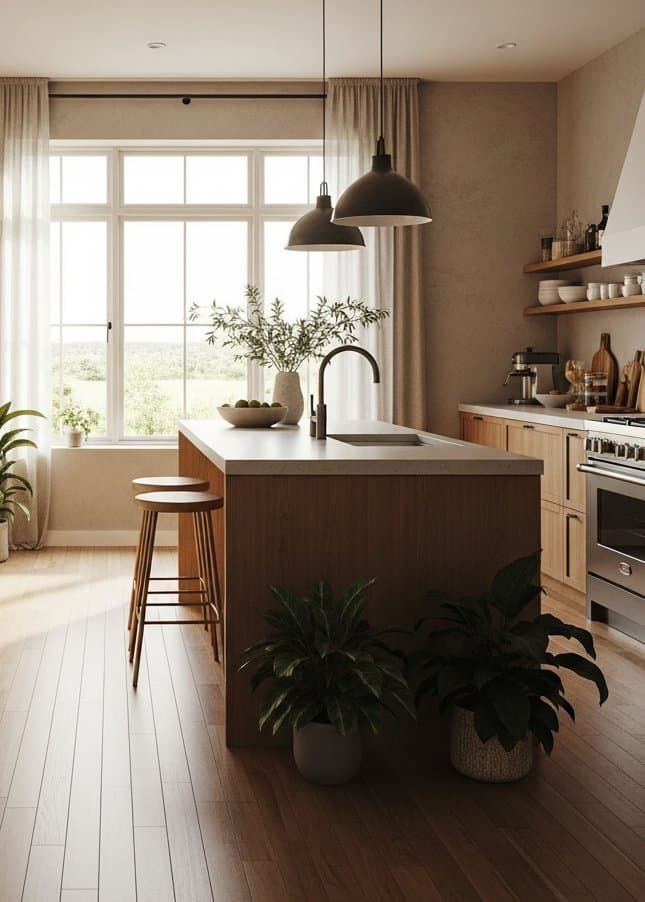
Currently one of the most popular layouts for open-plan living, the L-Shape places appliances along two adjacent walls. Its primary strength is its ability to naturally open up to a dining area or island, preventing the cook from being isolated from guests. The downside is the creation of a deep corner cabinet, which requires specialized storage solutions like Lazy Susans to remain accessible. On its own, the work triangle in an L-Shape can be quite long, so adding an island is often necessary to tighten the geometry.
The U-Shaped Kitchen
Surrounding the cook on three sides, the U-Shape offers the maximum amount of benchtop and storage space relative to the floor area. It is the ultimate "cockpit" for a serious solo cook, allowing efficient movement between zones with minimal steps. However, careful attention must be paid to the width of the "U." If it is too wide, the steps between the fridge and sink become tiring; if too narrow, the space can feel enclosed, and two cooks will struggle to work together without colliding.
The Single Wall Kitchen
Common in apartments and studios, this layout anchors all appliances and cabinets to one wall. In reality, this layout does not form a triangle but rather a straight line. This is generally the least efficient workflow, as the cook must traverse the entire length of the kitchen repeatedly. To improve functionality, architects often add a mobile island or a dining table parallel to the wall to create a "landing zone" and mimic the efficiency of a Galley layout.
The Two-Cook Kitchen
Modern homes often have multiple people preparing meals simultaneously, and a standard single triangle will inevitably result in collisions. The architectural solution is to create "Double Work Triangles."
This configuration often involves adding a second, smaller prep sink to the layout. One cook operates the main Sink-Stove-Fridge triangle, while the second cook operates a secondary Sink-Fridge-Prep triangle. The golden rule for traffic flow in this scenario is that the secondary triangle should align with one leg of the primary triangle but should never cross directly through the main work zone.
Summary
A beautiful kitchen that ignores these dimensions will be frustrating to use. Whether you choose a Galley for efficiency or an L-Shape for connection, the goal is to respect the fundamental geometry of the work triangle and preparation zones.