Bedroom - Part 4 - Lighting, Power, and Comfort
Bedroom Technicals: Lighting, Power, and Comfort
You can have the most expensive linen and a custom bedhead, but if you have to crawl under the bed to find a power point, or if a downlight is blinding you while you try to read, the room has failed.
The technical systems of a bedroom—lighting, power, and climate control—are what separate a standard builder-grade room from a custom architectural sanctuary. Here is how to get the wiring right.
1. Electrical Planning: The "Hotel" Logic
In a master suite, we steal a trick from 5-star hotels: Two-Way Switching.
The Problem: You walk into the room, turn the light on at the door, get into bed, and realize you have to get back up to turn the main light off.
The Solution: The main room lights must be switchable from the doorway and from the bedside.
The Master Switch: Ideally, place a "Master Off" switch at the bedside that kills all lighting in the room (including the walk-in robe and ensuite accent lights). This ensures total darkness with one click.
Power Point Placement
Bedside power is non-negotiable, but placement matters.
Standard Height: If you use standalone bedside tables, GPOs (General Power Outlets) are typically placed 600mm–650mm above the floor. This hides them behind most standard drawers.
Visible Access: If you want easy access for phone chargers, we often install GPOs with integrated USB-C ports just above the bedside table height (approx. 750mm).
The Future-Proof Move: Do not forget to wire a power point high on the wall or ceiling near the windows. This allows you to install motorized curtains or blinds later without ugly trunking running up the wall.
2. Lighting Design: Protecting Your Sleep
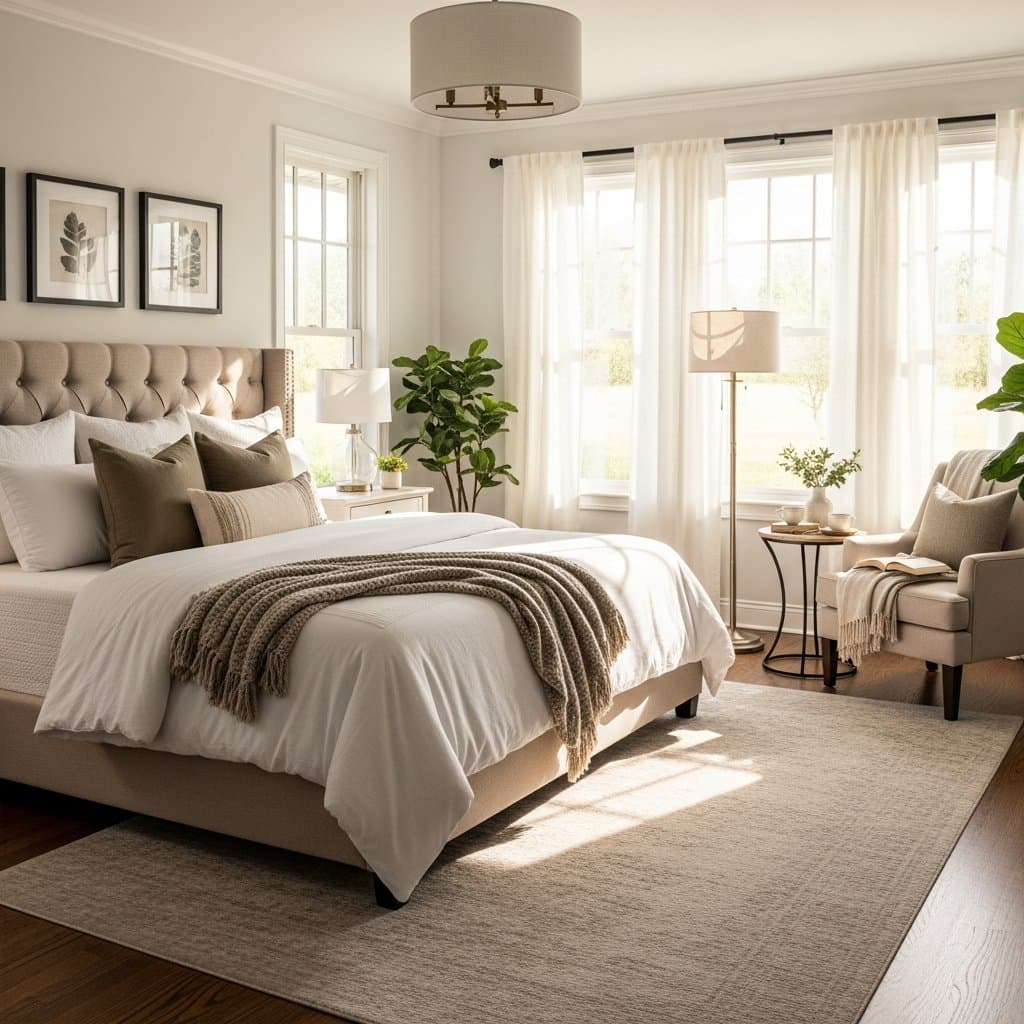
Lighting has a direct biological impact on sleep. Blue-spectrum bright light suppresses melatonin. Therefore, bedroom lighting must be soft, warm, and indirect.
The "No Downlight" Zone
A common mistake is placing a grid of downlights directly over the bed. This means when you lie down, you are staring into a blinding LED beam.
The Fix: Push downlights to the perimeter of the room (washing the walls or wardrobe doors) or avoid them entirely.
Ambient Light: Use indirect sources like hidden LED strips in a bulkhead or a ceiling fan with an integrated (dimmable) light.
Reading Lights
Task lighting should be focused.
Wall Sconces: Mounting adjustable reading lights on the wall saves precious surface area on your bedside table. Ideally, these are switched individually at the plate so you can read without waking your partner.
Colour Temperature: Always specify Warm White (2700K or 3000K) globes for bedrooms. Cool white (4000K+) belongs in the garage, not the bedroom.
3. Climate Control: Airflow and Fans
In the Australian climate, airflow is critical for sleeping comfort.
Ceiling Fans
Fans are the most efficient way to cool a room quietly.
Placement: The fan should be centered over the bed for maximum effectiveness.
Sizing: A standard 1200mm (48") fan is suitable for a 3x3m room. Larger master suites (4m+) benefit from a 1400mm (56") fan to move air slower and quieter.
DC vs. AC: We recommend DC (Direct Current) fans. They are whisper-quiet (no motor hum) and allow for very low speeds, providing a gentle breeze rather than a wind tunnel.
Air Conditioning
If installing a split-system or ducted vent, never place it directly opposite the bed blowing onto your face. This dries out eyes and sinuses.
Correct Placement: Vents should be directed to blow across the foot of the bed or parallel to the ceiling to cool the ambient air mass.
Summary
A great bedroom is one where the technology supports your rest without being intrusive. By placing switches where your hands naturally reach and keeping light sources soft and warm, the room actively helps you sleep.
Ready to design a home that works as well as it looks? Contact OAK Architecture and Design to start your journey.