Bedroom - Part 2 - Storage
Bedroom Storage: Walk-In Robes vs. Built-Ins
By OAK Architecture and Design
In a modern home, the bedroom is a sanctuary, but nothing destroys serenity faster than clutter. A chair piled high with laundry or a wardrobe bursting at the seams is a sign of poor planning, not just messy habits.
Whether you are designing a compact guest room or a sprawling master suite, the choice between a Built-In Robe (BIR) and a Walk-In Robe (WIR) comes down to square meterage and geometry.
The Built-In Robe (Reach-In)
For standard bedrooms (typically 3.0m x 3.0m to 3.6m x 3.6m), the Built-In Robe is the undisputed king of efficiency. It offers maximum storage with a minimal footprint.
The Golden Rule of Depth: The absolute critical dimension for hanging clothes is 600mm.
Standard coat hangers are roughly 450mm wide.
Bulky coats and sleeves add bulk.
If the internal depth is less than 580mm, your sleeves will get crushed against the doors, or sliding doors will jam.
Doors: Sliding vs. Hinged
Hinged Doors: Offer the best access (you can see the whole wardrobe at once) but require clear floor space in front of the robe to open.
Sliding Doors: Essential for tight rooms where the bed is close to the robe. However, you can only ever access 50% of the wardrobe at a time.
The Walk-In Robe (WIR)
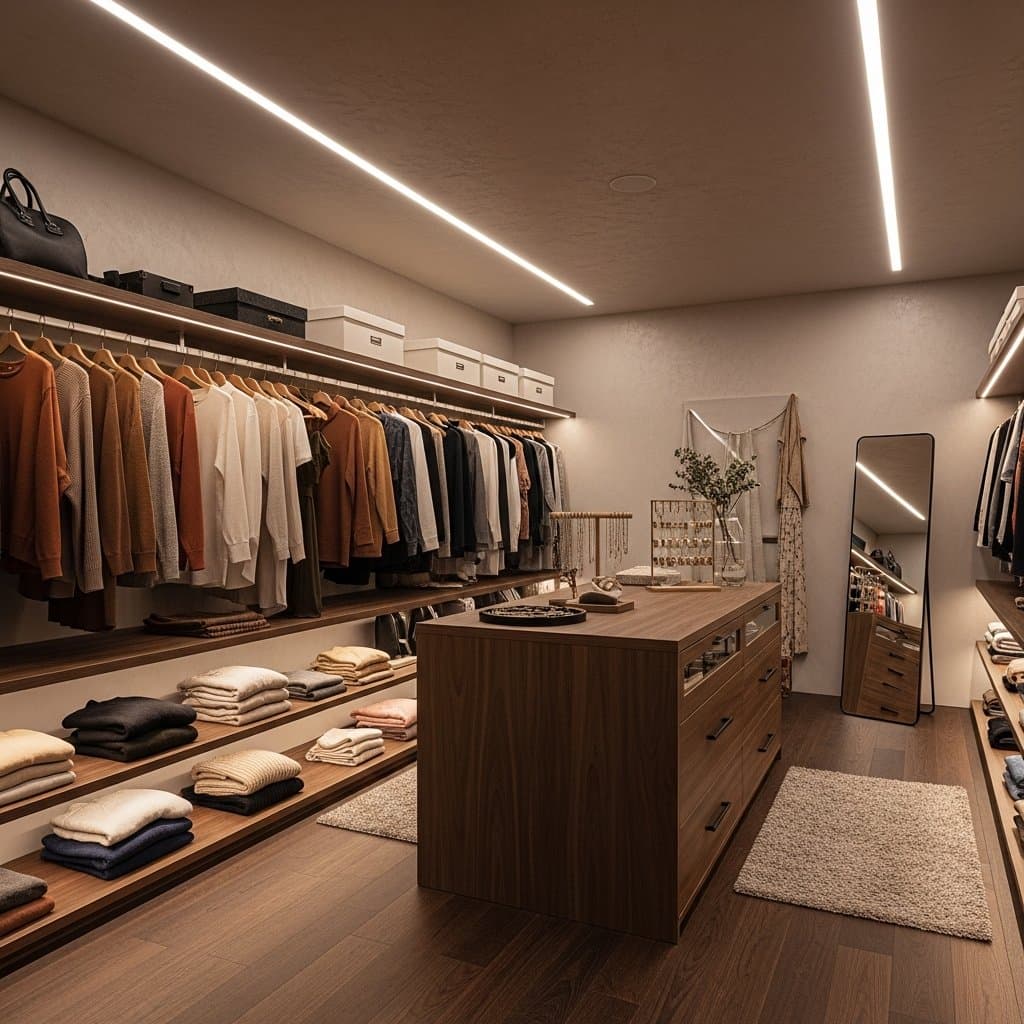
The Walk-In Robe is a symbol of luxury, but it is often the most poorly designed room in the house. A common mistake is forcing a WIR into a space that is too small, resulting in less storage than a standard wall of built-ins.
The Math of a Walk-In: A WIR is essentially a corridor lined with storage. To function, you need:
Storage Depth: 600mm for hanging space.
Walkway: A minimum of 900mm for comfortable movement.
Minimum Widths:
Single-Sided WIR: Requires a room width of 1.5 metres (600mm storage + 900mm walk).
Double-Sided WIR (Galley): Requires a room width of 2.1 metres (600mm + 900mm + 600mm).
The "U-Shape" Trap: Corners in WIRs are inefficient. Hanging clothes in corners often creates dead space. A "Galley" style (two parallel straight runs) is almost always more efficient than a U-shape.
The "Dressing Circle"
A Walk-In Robe is not just for storage; it is for dressing. If you plan to get changed inside the room, a 900mm aisle is tight. You need a "Dressing Circle"—a clear diameter of roughly 1200mm to 1500mm. This allows you to extend your arms to put on a jacket or bend down to tie shoelaces without hitting your elbows on the cabinetry.
Internal Logic: Hanging Heights
Custom joinery allows you to maximize vertical space. We typically zone the robe based on clothing length:
Double Hang (Shirts & Trousers): This doubles your storage. One rail sits at 1050mm and the upper rail at 2100mm.
Long Hang (Dresses & Coats): Requires a rail height of 1600mm to 1800mm.
The "Dead Zone" (Above 2100mm): This space is hard to reach. It should be reserved for shelving to store seasonal items like suitcases, blankets, or hats.
Summary
The best storage is invisible. Whether you choose a sleek wall of Built-Ins or a luxurious Walk-In, the success of the design lies in the depth and the clearance. If the dimensions are right, the clutter disappears.
Are you ready to build a home where every detail is designed for your lifestyle? Contact OAK Architecture and Design to design your dream home.