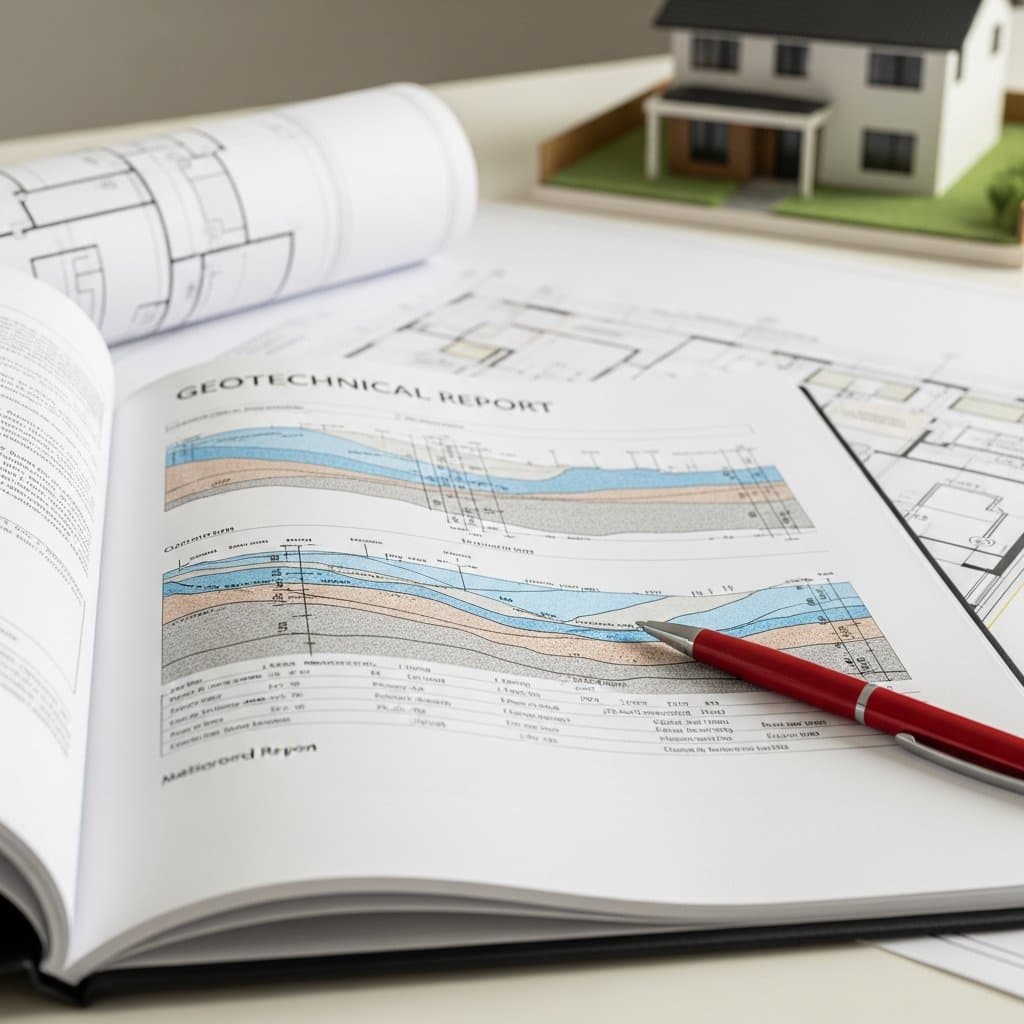
Document - Geotechnical Report – Knowing what your site can truly support
What is a Geotechnical Report and Why Do I Need It for My DA?
When you look at a block of land, you see grass, trees, and soil. What actually determines how your home must be built, however, is what lies beneath the surface. Clay, rock, sand, uncontrolled fill, or reactive soils all behave very differently, and each demands a specific structural response.
A Geotechnical Report removes uncertainty from the design and construction process. Without it, structural engineers are forced to make assumptions, and builders cannot provide reliable pricing. Understanding your ground conditions early is one of the most effective ways to protect both the safety of your home and your construction budget.
A Geotechnical Report is prepared by a qualified Geotechnical Engineer. The report analyses the physical and mechanical properties of the soil and any underlying rock across your site.
To obtain this information, the engineer drills boreholes at selected locations and extracts soil samples for laboratory testing. These tests reveal how stable the ground is, how it behaves when wet or dry, and whether it is prone to movement, swelling, or shrinkage over time. This data forms the foundation for all subsequent structural design decisions.
Why do you need it for a DA/CC or CDC?
While some Councils may not require a geotechnical report at the very first stage of a Development Application, it is essential for obtaining a Construction Certificate or a Complying Development Certificate.
Structural engineers rely on this report to design slabs, footings, and retaining systems that are appropriate for the site conditions. The soil classification determines the amount of concrete, reinforcement, and depth of footings required to safely support the building.
Geotechnical information is also critical on sloping sites or in areas known for instability. In these situations, Councils often require a Geotechnical Stability Assessment to demonstrate that the proposed development will not be affected by landslip or ground movement.
From a cost perspective, the report is equally important. Builders who quote without a soil test are effectively guessing. If unexpected rock, soft soils, or deep fill are encountered during excavation, significant variations can follow. A geotechnical report allows these risks to be identified and priced accurately from the outset.
What information is included in a Geotechnical Report?
The most important piece of information for you and your architect is the Site Classification (based on Australian Standard AS 2870).
Common classifications you might see include:
Class A or S: Stable or slightly reactive (good soil).
Class M or H1/H2: Moderately to Highly reactive clay (very common in Sydney). This means the soil expands when wet and shrinks when dry, requiring stronger footings.
Class P: "Problem" site. This usually means there is uncontrolled fill, soft soil, or trees causing abnormal moisture conditions. These sites require custom engineering.
The report will also verify the Bearing Capacity (how much weight the soil can hold) and the Salinity levels (salt in the soil can eat concrete/steel).
When is it required?
Ideally, a geotechnical report should be obtained during the design development stage, before structural engineering begins. Early testing allows the design team to respond intelligently to site conditions.
If the report identifies highly reactive soils, deep fill, or hard rock, architectural and structural strategies can be adjusted to reduce excavation, minimise footing costs, or avoid unnecessary construction complexity. Leaving this investigation too late often results in expensive redesigns or unexpected cost increases.
Common Pitfalls and Professional Advice
One of the most significant financial risks lies in sites that have been artificially levelled. Uncontrolled fill—loose soil placed without proper compaction—cannot support conventional footings.
A geotechnical report will identify the depth and extent of fill, but the solution often involves piering: drilling concrete piers through the fill to reach stable ground below. This is an effective but costly process, and it is far better to budget for it early than to discover the requirement after construction has commenced.
At OAK Architecture and Design, we treat geotechnical information as a design tool rather than a compliance hurdle. Understanding the ground conditions allows us to make informed decisions that balance structural performance, construction cost, and architectural quality.
How to obtain a Geotechnical Report
A geotechnical engineer will attend your site with a small drilling rig, usually capable of accessing residential blocks. They drill several boreholes, collect samples, and carry out laboratory testing before issuing the final report.
We manage this process for our clients by coordinating directly with the engineer. We provide the survey plan to ensure boreholes are located accurately and handle the administrative side of engaging the consultant. This removes the burden of managing multiple technical specialists and ensures the information is delivered when it is most useful to the design process.
Don't let bad soil blow your budget.
The key to a safe, cost-effective build lies beneath the surface. Understanding your site conditions early allows for accurate engineering, reliable pricing, and fewer surprises during construction. If you need help coordinating soil tests and engineering for your new home, contact OAK Architecture and Design today.